
Is Your Organization a High-Performance Engine or a High-Friction Cage?
We’ve all seen it: A leadership team spends months architecting a "perfect" strategic blueprint, only to watch it stall the moment it hits the floor.
Why? Because they built a Mechanistic engine for an Organic world.
In my work as a Behavioral Architect at Knsenn Consulting, I’ve realized that most organizational failure isn’t a strategy problem—it’s a Behavioral Infrastructure problem.
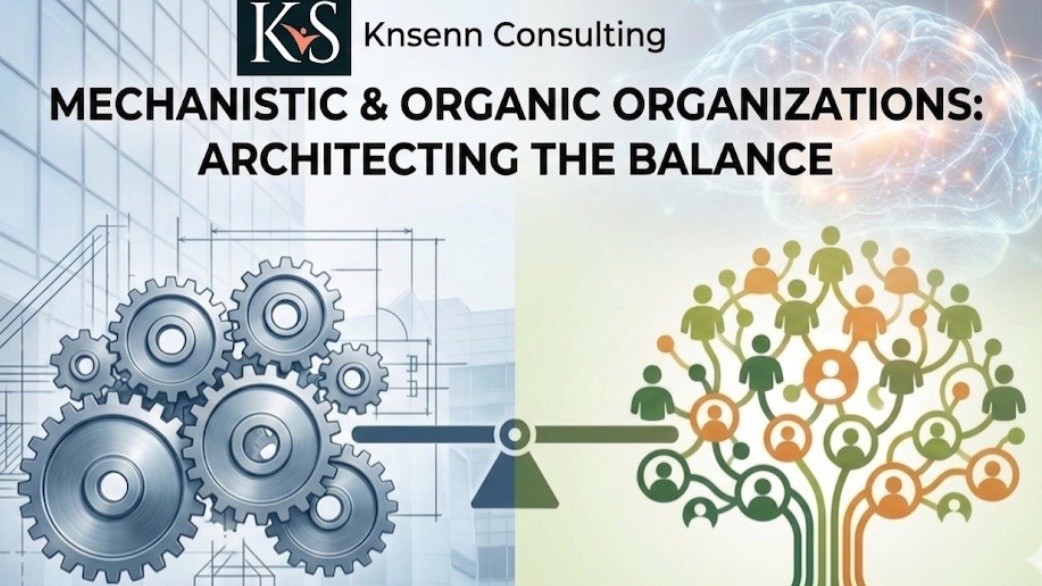
Early in the industrial age, Henry Ford mastered the Mechanistic Model. It was all about hierarchy, repetitive tasks, and zero autonomy. It was efficient for moving parts, but it was a "behavioral cage" for people. It minimized the human impact to maximize the output.
Then came Toyota. They realized that by treating the organization as an Organic Model—one that prioritizes "people factors," cross-functional trust, and autonomy—they didn't just build cars; they built a culture of continuous improvement.
The Lesson for Today’s Leaders: A mechanistic structure feels stable, but it creates "Human Friction." An organic structure feels fast, but without the right behavioral profiling, it can feel like chaos. Your job isn’t to choose one; it’s to architect the balance.
We often look at leadership through "Traits"—Extroversion, Conscientiousness, or Emotional Intelligence. These are great indicators of who will become a leader, but they don't predict who will be an effective one.
True leadership is a behavioral choice.
As an I/O Psychologist, I look at two specific behavioral drivers:
1. Initiating Structure: How you define the roles and goals.
2. Consideration: How you build trust, respect, and psychological safety.
If you have all the structure but zero consideration, you have a compliance culture. If you have all the consideration but no structure, you have a country club. Success lies in Behavioral Precision—knowing exactly which lever to pull based on the specific "Behavioral DNA" of your team.
Many leaders think empathy is a "soft" skill. It’s not. It’s a Strategic Implementation Tool.
Research shows that transparent, empathetic leadership is the primary driver of trust. And trust is the only thing that increases Adoption Velocity. When your team feels like they are "co-architects" of the change, the resistance disappears.
When I conduct a behavioral audit for a client, I’m not just looking at their spreadsheets. I’m mapping their Team Behavioral Dynamics. I’m finding the hidden friction points where communication breaks down and where High-Structured leaders are accidentally stifling innovation.
A healthy work environment isn't just a "nice-to-have" perk. It is the foundation of your financial ROI. If you want to move your team from reactive management to proactive enterprise steering, you have to look at the human performance infrastructure.
Ask yourself:
- Is my leadership style directive when it needs to be supportive?
- Is my organizational model creating safety or creating stress?
- Am I leading by habit, or am I leading by design?
Performance is the outcome. Behavior is the architecture. If you don’t design the behavior, the behavior will design your results.
Kaitlin Lozano-Senn, MSExecutive Behavioral Specialist | Knsenn ConsultingLLC
I help leaders bridge the gap between strategy and human behavior by eliminating the friction that stalls success.
Blake, N. (2025). A Multimodal Approach to Transform Culture by Implementing AACN’s Healthy Work Environment Standards. Critical Care Nurse, 45(5), e1–e9. https://doi-org.lopes.idm.oclc.org/10.4037/ccn2025911
Meng, J., Pan, P.-L., Cacciatore, M. A., & Sanchez, K. R. (2024). The integrated role of adaptive leadership, sense of empathy and communication transparency: Trust building in corporate communication during the pandemic. Corporate Communications, 29(4), 503–515. https://doi-org.lopes.idm.oclc.org/10.1108/CCIJ-09-2023-0125
Robbins, S. P., & Judge, T. A. (2023). Organizational behavior (19th ed.). Pearson/Prentice Hall. ISBN-13: 9780137474646
Udin, U., Fitriani, K., & Dananjoyo, R. (2025). Linking empowering leadership and work environment with employee performance: The mediating role of job stress. Work, 81(1), 2415–2424. https://doi-org.lopes.idm.oclc.org/10.1177/10519815241311163
Wilson, J. M. (2013). Henry Ford vs. assembly line balancing. International Journal of Production Research, 52(3), 757–765. https://doi.org/10.1080/00207543.2013.836616
Yang, C.-C., & Yang, K.-J. (2013). An integrated model of the Toyota Production System with total quality management and people factors. Human Factors and Ergonomics in Manufacturing & Service Industries, 23(5), 450–461. https://doi.org/10.1002/hfm.20335