
To Lead is to Sacrifice: Why Behavioral Precision is the Language of Leadership
Many people view leadership as a tool to meet the expectations of a business. In reality, leadership is an act of sacrifice. It is the constant process of changing oneself to cultivate strong relationships while pushing people to deliver their best.
At Knsenn Consulting, we believe the crux of modern leadership lies in one thing: Effective Communication. As leadership consultant James Humes once said, “The art of communication is the language of leadership.” If you want to move your business initiatives forward, you must first master the power dynamics and communication patterns that define your organizational culture.
In every office, there is a shift in power dynamics between management and subordinates. According to French and Raven’s classic theory, there are five primary styles of power. Successful leaders don't just rely on one; they adapt based on the person in front of them.
- Expert Power: Derived from your unique knowledge.
- Legitimate Power: Derived from your formal title.
- Reward & Coercive Power: The ability to grant incentives or apply discipline.
- Referent Power: The most sustainable form—power given to you by employees who view you in a positive, respectful light.
The Research Insight: Studies show that "Referent" and "Expert" power leads to higher emotional commitment from employees. At Knsenn, we help leaders move away from purely "Legitimate" (title-based) power and toward "Referent" power to drive long-term retention.
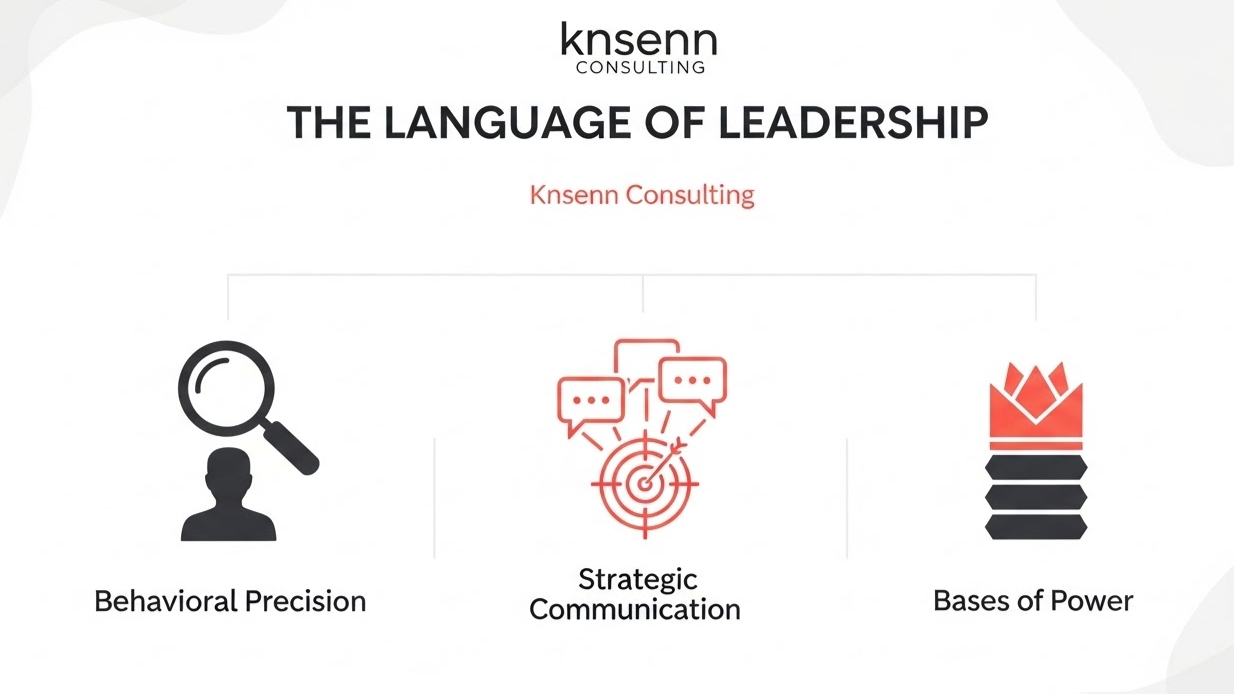
There is no "one-size-fits-all" leadership style. Whether you are a Tactical Leader (focused on strategy), an Affiliative Leader (focused on compassion), or a Participative Leader (focused on shared decision-making), your success depends on the situation.
According to Fiedler’s Contingency Theory, leaders must assess their personal preferences and adapt to fit the environment. This requires three things:
- Self-Awareness
- Self-Reflection
- Self-Transcendence
A leader who understands their own behavioral drivers—the core of our work at Knsenn—can readily adapt to the needs of their team, creating a healthier work environment and strengthening team efficacy.
Accurate communication is the "engine" of an efficient organization. However, many leaders accidentally create "structural holes" or silos.
Our research indicates that Symmetrical Internal Communication—a two-sided dialogue where employee feedback is actually incorporated—heightens an employee’s perception of organizational support. When employees see their ideas implemented, they identify more deeply with the organization. They stop being "staff" and start being "partners."
As your company grows, communication patterns naturally emerge. If you don't manage them, the "Grapevine" will.
- Upward Communication: Are your employees "coaching up," or are they too nervous to speak to leadership?
- Downward Communication: Are you relaying directions timely, or is there a bottleneck at the VP level?
- Business Communication: Is cross-functional collaboration happening, or is every department an island?
- Informal Communication: The "watercooler" talk. While it builds trust, it can also spread gossip through cluster grapevines.
Ultimately, a leader’s role is not to simply wield power, but to master the channels through which information flows. By consciously applying these behavioral theories, you can build a culture that is well-directed, collaborative, and resilient.
Leadership is malleable. Change is always possible with the right data and mindfulness.
Are you ready to audit the behavioral health of your leadership team? Let’s connect at Knsenn Consulting to bridge the gaps in your communication network.
Resources
Aamodt, A. G. (2023). Industrial Organizational Psychology: An Applied Approach (9th ed.). Cengage.
Beigzadeh, Y. & Mahbobkah, F. (2018). Investigating the Effect of Managers’ Power Resources on Emotional Commitment of Employees Considering the Mediating Role of Personality Characteristics of Entrepreneurship.185-161, (1). https://doiorg.lopes.idm.oclc.org/10.22059/jipa.2018.251737.2207
da Silva, A. W. P., Neto, A. R. V., de Araújo Lima Coelho, A. L., & de Castro, A. B. C. (2019). Correlations between power and affective organizational commitment. GeSec: Revista de Gestao e Secretariado, 10(1), 91–118. https://doi-org.lopes.idm.oclc.org/10.7769/gesec.v10i1.843
Li, N., Zheng, X., Ni, D., Kirkman, B. L., Zhang, M., Xu, M., & Liu, C. (2025). Leadership in a Crisis: A Social Network Perspective on Leader Brokerage Strategy, Intra-Organizational Communication Patterns, and Business Recovery. Journal of Management, 51(5), 2041–2073. https://doi-org.lopes.idm.oclc.org/10.1177/01492063241237227
Melfin. (2025). The Influence of Organizational Culture and Leadership Style on Employee Job Statisfaction. Greenation International Journal of Economics & Accounting (GIJEA), 3(1), 7–15. https://doi-org.lopes.idm.oclc.org/10.38035/gijea.v3i1.333
Ruoyu Sun, Jo-Yun Queenie Li, Yeunjae Lee, & Weiting Tao. (2023). The Role of Symmetrical Internal Communication in Improving Employee Experiences and Organizational Identification During COVID-19 Pandemic-Induced Organizational Change. International Journal of Business Communication, 60(4), 1398–1426. https://doi-org.lopes.idm.oclc.org/10.1177/23294884211050628
Rüzgar, N. (2018). The Effects of Decision-Making Styles of Leadership on Employees Knowledge Sharing within the Organization. Journal of Knowledge Economy & Knowledge Management, 13(2), 107–120.Schmidt, R. (2024). Servant-Leadership, Self-Reflection, and Self-Transcendence. International Journal of Servant-Leadership, 18(1), 619–640. https://doi-org.lopes.idm.oclc.org/10.33972/ijsl.421
Sheeba, M. F. L., & Rebekah, T. R. (2023). A Study on the Role of Emotional Intelligence in Leaders Hip Effectiveness. XIBA Business Review, 6(1), 1–7.
Snyder, S. (2023). Power roles (business science). Salem Press Encyclopedia.